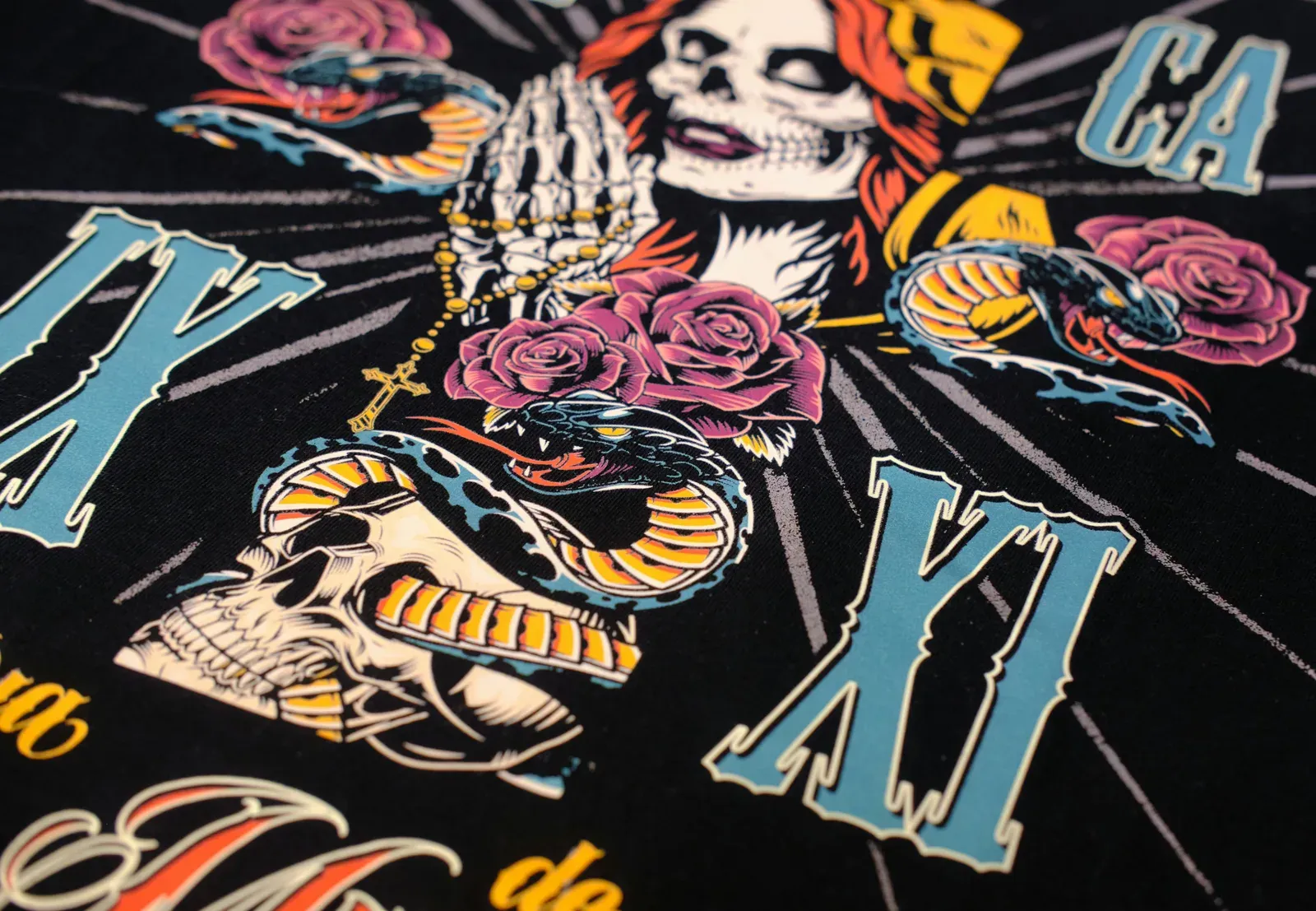
The call goes about like this. Somebody wants fifty more of the shirts they ordered for their crew “a while back.” They can’t remember the year. They remember the design.
Most of the time, we still have the screen.
That’s not luck. It’s a filing decision this shop made a long time ago and never went back on. There are over a thousand screens racked in this building, and a good number of them belong to customers who haven’t called in years.
What a screen actually is
A screen is a frame with fine mesh stretched over it, coated in light-sensitive emulsion and burned with your design so ink passes through the artwork and nowhere else. One screen per color. A three-color front and a one-color back is four screens.
Making them is real work: art prep, output, coating, burning, washing out, taping, lining up on the press. That work is the setup charge on your first order, and it’s most of what makes small screen-print runs expensive.
Why we keep them
Plenty of shops reclaim screens after a job. They strip the emulsion off, and the frame goes back in the rotation for the next customer. It saves space and it saves frames.
We keep yours instead. Space is the price we pay for that. You get the payoff.
What that means when you call back
Your reorder is faster. No art prep, no burning, no waiting on a new screen. Your job goes on the press with the current work instead of starting at the beginning.
Your reorder costs less. The setup was paid once. You don’t pay it again for the same design.
Your shirts match. This is the one people don’t expect and appreciate the most. A reprint from the original screen looks like the original run. New art redrawn from scratch never quite does. The line weights shift, the registration sits a hair differently, and suddenly year three of your uniform doesn’t match years one and two.
Embroidery works the same way
Digitizing (turning your logo into a stitch file) is a one-time setup on your first embroidery order. After that the file is ours to keep and yours to reuse. Reorders skip straight to production, whether that’s next month or four years from now.
What we still need from you
A screen on the rack isn’t a whole order. When you call for a reprint, have this ready:
- How many and what sizes, roughly. We can firm it up.
- The garment. If you want the exact same blank as last time, tell us; if the supplier discontinued it, we’ll find the closest thing and say so.
- Ink colors, if you want anything changed from the original run.
- Any change to the artwork. Even a small one means a new screen. A new year, a different phone number, one name added. That’s not us upselling, it’s physically a different stencil. Tell us up front and it’ll be in the quote.
You’ll still get a written quote and a proof, same as a first order. Nothing goes on the press until you approve it.
If you’re not sure we have yours
Call and describe it. Roughly when it was, what it was for, what was on it. That’s usually enough for somebody here to go look. If the mesh got damaged or the screen didn’t survive, we’ll tell you that too, and quote the reburn honestly instead of quietly slipping it in.
And if you’ve never printed with us
Then the first order pays the setup — once. After that your design is on the rack with everybody else’s, and the next call is the easy one.
Ready to reorder, or ready to start? Send it through the quote form or call the shop. If you’re still deciding how to decorate the job in the first place, screen print, embroidery, or DTF walks through the tradeoffs.